|
31 Down PERFORMANCES UNIVERSAL ROBOTS June 28-July 7, 2007 |
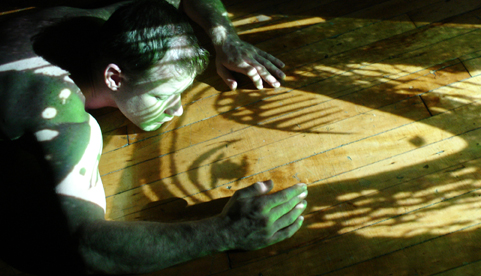
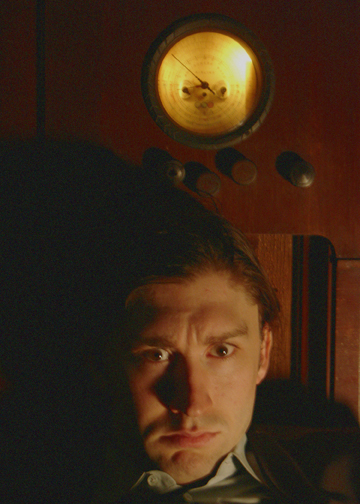
Play Video 1 | Play Video 2 |
31 Down radio theater presents
UNIVERSAL ROBOTS
in association with the Ontological-Hysteric Incubator
listen here >
Artistic Director: Ryan Holsopple
Written by Ryan Holsopple and Shannon Sindelar,
based on and borrowed from the writings of Karel Capek
Directed by Shannon Sindelar
Video Design by Mirit Tal
Scenic Design by Thom Sibbitt
Lighting Design by Jon Luton
Costume Design by Tara Fawn
Stove Design by Benjamin Brown
Sound Design and Music by Ryan Holsopple,
with additional design by Mike Rodasta and Benjamin Brown
Sound Engineering by Mike Rodasta
Cast:
Karel Capek/Primus: Justin Tolley
Josef Capek: Thom Sibbitt
Olga/Helena: Kelly Tuohy
The Great Caspian as Alquist: Ryan Holsopple
Leni/Robot: Shauna Kelly
Domin: Jonathan Valuckas
with the special guest voice of D.J.
Mendel
This work is set at the
beginning and the end of World War II and is an elegy for two brothers,
Karel and Josef Capek.
In the summer of 1938, Adolph Hitler
voiced active support of the highly publicized demands of the German
population of the Sudetenland in the Republic of Czechoslovakia, for
annexation of the region into Germany. Fearing the outbreak of war,
European leaders met in a conference at Munich on September 29, 1938.
Present were Eduard Daladier from France, Neville Chamberlain from England,
Mussolini representing Italy, Hitler, and Ribbentrop. Representatives
of Czechoslovakia and the Soviet Union were not invited.
Wanting to avoid the possibility of a
new European war, Chamberlain and Daladier submitted to Hitler's demands
very quickly; the conference was over the next day. The treaty ceded
three areas of Czechoslovakia to other powers: the Sudetenland was annexed
into Germany, the Teschen district was given to Poland, and parts of
Slovakia went to Hungary.
Chamberlain boasted after the conference
that they had achieved "Peace for our time," but the Munich
Agreement quickly became a symbol of the western powers' appeasement
of Hitler, which led to the outbreak of World War II one year later.
Karel Capek was one of the most influential
Czech writers of the twentieth century; he wrote detective stories,
travel books, fairy tales and books on gardening, however, he is most
famous for his science fiction works R.U.R and War With the Newts, illustrating
his fear of impending social disasters, dictatorship, violence, and
the unlimited power of corporations. In the late 1930s, Capek's work
focused on the threat of brutal Nazi and fascist dictatorships.
Soon after it became clear that the Western allies had refused to help defend Czechoslovakia against Hitler, Capek refused to leave his country--despite the fact that the Gestapo had named him
Czechoslovakia's "public enemy number
2." Karel died of double pneumonia on December 25, 1938, shortly
after part of Bohemia was annexed by Nazi Germany.
Josef Capek was a writer, painter and
illustrator. He wrote plays with his brother Karel and coined the term
'robot' in 1920. The word is derived from the noun robota, meaning "forced
labour, corvée, drudgery" in the Czech language and being the
general root for work in other Slavic languages.
Due to his critical attitude towards
Nazism and Adolf Hitler, Josef was arrested after the German invasion
of Czechoslovakia in 1939. He wrote 'Poems from a Concentration Camp'
in the concentration camp of Bergen-Belsen, where he died in 1945.
All visual images in this production are taken from the works of Josef Capek.
A very special thanks
to Hal Eagar, Jan and Dale Sindelar, Susanna Lee Holsopple, Betty Holsopple,
Morgan Pecelli, Ian Allen, Brendan Regimbal, Ann-Marie Reilly and the
American Folk Art Museum, Kevin Lindamood, William Cusick, Yoav Gal, and Melanie Neergaard.
All sounds are created originally by
Ryan Holsopple and are also assembled from sounds from the Free Sound
Project. Licensed under Creative Commons. For the Free Sound attribution
list please GO HERE.
UNIVERSAL ROBOTS was developed with the facilities and support of Gertrude Stein Repertory Theatre’s Digital Performance Institute artist residency program http://digitalperformance.org